Pinned, Posted, Passed On: The Quiet Network That Keeps Stapleford in the Loop
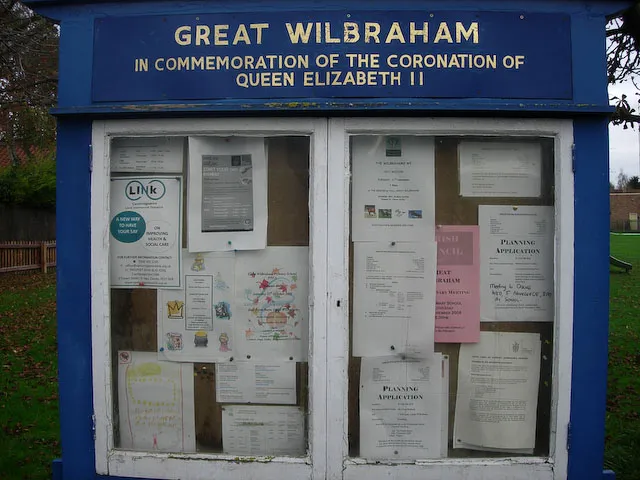
Photo: Hugh Venables, CC BY-SA 2.0, via Wikimedia Commons
There is a particular kind of Stapleford conversation that begins with a slight lean and the words, 'Have you seen the noticeboard?' It is not a question about cork. It is a question about whether you are in the loop. In a town where the what's on can live on a laminated A5 poster in a shop window, the humble noticeboard is not a relic. It is infrastructure.
We spent a week following the paper trail. We loitered in the library foyer, squinted at shop windows, asked the people who run the local Facebook group why they do it, and stood in front of the parish board long enough that someone asked if we were lost. We were not lost. We were learning how Stapleford actually finds out what is happening.
The corkboard economy
A noticeboard is a small, public argument about what matters. On one board you might find a coffee morning, a missing cat, a yoga class, a church fete, a warning about a road closure, and a poster for a band playing in the function room of a pub. The order is not alphabetical. It is emotional. The things pinned at eye level are the things someone cares about enough to pin twice.
'The trouble is not getting people to put things up,' says one volunteer who helps look after the parish board. 'It is getting people to take things down. You get a lovely poster for a summer fair and then it is November and it is still there. We have a quiet sort of tidy-up every few weeks. Otherwise the board becomes a museum of things you have already missed.'
That is the first lesson of the noticeboard: it is always slightly behind and slightly ahead at the same time. It carries the last event and the next one. If you want to know what Stapleford is doing, you have to read it like a local newspaper with a very short deadline.
The library foyer: Stapleford's accidental newsroom
The library foyer might be the most democratic information space in town. You do not need to buy a coffee or a pint to stand there. You do not need to be on a mailing list. You just need to be passing and curious. The board near the entrance is a mix of council leaflets, reading group notices, craft sessions, and the occasional handwritten plea for a lift share.
What is striking is how much of it is aimed at people who are not online. Not because they are invisible, but because they are busy, or older, or simply tired of scrolling. A printed notice is a different kind of invitation. It says: this is happening, in a real room, and you can come.
'We get a lot of people who come in just to check the board,' says a library volunteer. 'They might not borrow a book. They might not use a computer. They just want to know what is going on. It is part of the service, really. We are a place where information lands.'
Shop windows and the art of the angled poster
Then there are the shop windows. The greengrocer. The hairdresser. The café with the good sausage roll. Each window is a tiny gallery of local life, and each one has its own curatorial style. Some are neat. Some are chaotic. Some have a poster so old it has faded into a kind of local history exhibit.
Shopkeepers do not have to do this. No one is paying them to tape a flyer to the inside of their glass. They do it because they know their customers. They know that the person buying a paper and a pint of milk might also be the person who wants to know about the choir concert or the scout jumble sale. The window is a favour, passed on.
'You can tell what is going to be busy by what people ask about,' says one shop owner. 'If a poster goes up for something with kids, we get asked about it all week. If it is a quiz night, we get asked by a different set of people. It is not scientific. It is just knowing your street.'
The Facebook group and the WhatsApp chain
Of course, the digital network is real too. The local Facebook group is where the fast stuff happens: lost dogs, roadworks, a last-minute cancellation, a plea for a recommendation. It is useful, noisy and occasionally magnificent. It is also where the same question gets asked every fortnight, which is either a flaw or a sign that the group is doing its job.
Behind the group are admins who approve posts, delete spam and try to keep the tone from tipping into a full-scale argument about parking. They are not paid. They are not thanked enough. And they are often the first to know when something is happening.
Then there is the WhatsApp chain. The school gate chain. The work chain. The family chain. The chain that exists solely to coordinate who is bringing the folding table to the village hall. These are the invisible wires of local life. A message goes out: 'Can you share this?' And suddenly a small event has an audience.
'People think it is all Facebook now,' says one group admin. 'But the WhatsApp groups are where the real organising happens. You can post something on Facebook and get a hundred likes and nobody turns up. You put it in the right WhatsApp group and you get twelve people and a rota for the tea urn.'
What falls through the gaps
The noticeboard network is not perfect. It misses people. If you are new to town, or you do not use social media, or you cannot get to the library, you can feel like everyone else has a map you do not have. Events that are only advertised online can vanish from the paper trail. Last-minute changes do not always make it to the pinned poster. And some of the most useful information is the least glamorous: bin collections, road closures, a change to the bus timetable.
There is also the quiet problem of the same people doing the pinning. A small number of organisers keep the boards alive. They are the ones with the stapler, the Sellotape and the patience. If they stop, the board goes stale. That is not a reason to panic. It is a reason to say thank you, and maybe to pin something yourself.
Your practical guide to being in the know
If you want to stop scrolling for hours and start finding out what is actually on, here is a simple Stapleford routine.
- Check the library foyer first. It is free, indoors and usually has the widest mix of notices.
- Look at shop windows, not just the ones you use. The hairdresser, the café and the corner shop often carry different posters.
- Read the parish board properly. Not just the big posters. The small handwritten cards are where the odd, lovely things hide.
- Join one local Facebook group, not five. Mute the noisy ones. Check the group once a day rather than living in it.
- Ask to be added to the right WhatsApp chain. The school one, the street one, the club one. Be the person who shares the poster, not the person who asks what time it starts.
- If you are organising something, do both. Print a poster and post it online. Put the time, date, place and cost in large letters. Then ask a friend to share it.
- Take your posters down when the event is over. The noticeboard is a public service, not a permanent exhibition.
The noticeboard is us
The odd thing about all this is that the network is not really made of cork or pixels. It is made of people who bother. The volunteer who tidies the board. The shopkeeper who says yes to the poster. The admin who approves the post at 10pm. The friend who forwards the message. The person who stops in the library foyer and actually reads it.
Stapleford is not a huge place. That is the point. The information does not need to travel far. It just needs someone to pin it, post it, or pass it on. So next time you see a noticeboard, do not walk past it. Have a look. You might find the thing you were going to spend forty minutes scrolling for. And if you are the one with the stapler, thank you. The rest of us owe you a cup of tea.