The Paint That Stayed: Reading Stapleford's Ghost Signs, One Wall at a Time
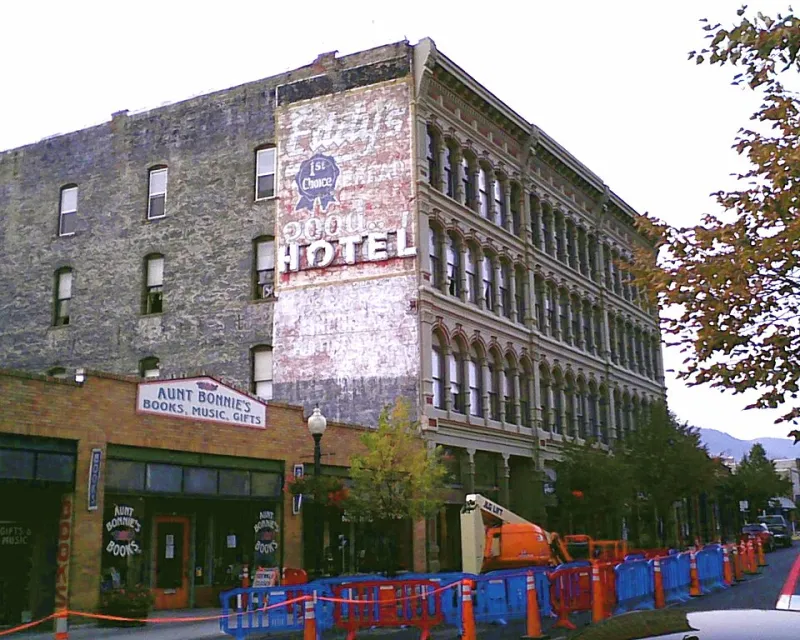
Photo: Montanabw, CC BY-SA 3.0, via Wikimedia Commons
There's a wall on Church Street that has been quietly advertising something since before most of us were born. The paint has thinned to a whisper — cream letters on soot-dark brick — and unless you're the sort of person who looks up, you'll walk straight past it on the way to the Co-op. But once you've seen it, you can't unsee it. And once you've seen one, you start seeing them everywhere.
Ghost signs are the tattoos of a high street. They're the adverts that were painted straight onto the building, back when a shopkeeper's best marketing budget went on a signwriter with a steady hand and a pot of lead-based white. When the shop changed hands or closed, the sign was usually painted over — but paint has a long memory, and weather has a way of peeling back the years. What's left is a palimpsest: three businesses stacked on one wall, each one fading at a different speed.
Why the walls talk louder than the plaques
Stapleford isn't short of official history. There are plaques, there's the church, there's the whole Broxtowe archive if you fancy a rainy afternoon indoors. But ghost signs are different because nobody preserved them on purpose. They survived by accident — because the render held, because the replacement sign went up on a board instead of the brick, because a later owner couldn't be bothered to scrape back to bare masonry.
That accident is what makes them honest. A plaque tells you what a committee decided was worth remembering. A faded sign tells you what people actually bought, drank, smoked and insured against in 1911.
Local historian Margaret Hallam, who has been photographing the town's painted adverts since the 1990s, puts it neatly. "You can date a wall by its layers," she says. "The bottom layer is usually a grocer or a draper. The middle one is often an insurance company or a brewery. The top layer, if there is one, is usually a national brand — somebody like Player's or Bovril, paying the shopkeeper a few shillings to lend them the gable end. It's a stratigraphy of commerce."
A forty-minute loop, best done slowly
You don't need a guidebook. Start at the bottom of Derby Road, near the canal bridge, and walk up towards the town centre with your eyes at first-floor height. That's where the money went — above the shopfront, where the signwriter had a clear run of brick and nobody could park a van in front of it.
Turn onto Church Street and slow right down. There's a butcher's sign here, half-eaten by a later coat of masonry paint, where you can still make out the surname and the word 'Family' before it. Further along, on the gable of a building that's now something altogether more modern, there's a pale rectangle advertising groceries and provisions — the sort of lettering that used to be read from a moving tram.
Loop round Victoria Street and Albert Street, then back down towards the crossing. The whole thing is under a mile and takes about forty minutes if you stop. Which you will.
A word of practical advice: bring a phone torch, come on an overcast day rather than a bright one, and photograph from an angle rather than head-on. Raking light is what makes faded paint legible. Noon in July will flatten it to nothing.
The chemist, the cobbler and the coal merchant
Not every sign is a national brand. Some of the best are stubbornly local — the sort of name that only means anything to people who've lived here long enough to remember the shop itself.
Doreen Marshall, who's lived off Hickings Lane since 1968, remembers one of them clearly. "There was a cobbler's on the corner and his name was painted right up the side of the building in big gold letters," she says. "You couldn't miss it. When he retired, the shop became a hairdresser's, then a takeaway, and the sign just stayed there, looking down on all of them like a disapproving uncle. I think it's still there under the render."
That's the thing about these signs. They outlast the trades they advertise. A coal merchant's name survives into an era of gas boilers. A soap advert promising 'health and cleanliness' survives into a world of hand sanitiser and laundry pods. The wall becomes a small, accidental museum of things Stapleford no longer needs but once couldn't do without.
What the old photographs show
Margaret Hallam's archive is the place to start if you want to see the signs in their prime. She's collected postcards and family snapshots from across the Erewash side of the borough, and the difference between then and now is startling. In a 1930s photograph of the high street, nearly every building carries lettering. It's a wall-to-wall chorus of names — bakers, bootmakers, cycle agents, a shop selling 'fancy goods' that nobody has satisfactorily explained to me.
The street itself was darker then, of course. Coal smoke, no street lighting to speak of, and shopfronts that relied on daylight and a single bulb. The signs weren't decoration. They were the advertising.
What will 2076 read on our walls?
Here's the uncomfortable question. If a future Margaret Hallam walks down Derby Road in fifty years, what will she find left over from 2026?
The honest answer is: probably very little. Vinyl graphics peel. Illuminated box signs get taken down and sold for scrap. Acrylic lettering leaves nothing behind but a row of drill holes, and even those get filled. We've traded paint for print, and print doesn't ghost.
There are exceptions, and they're worth celebrating. A few independent shopfronts in town still use hand-painted lettering on glass or board — the sort of thing that will leave a shadow if the shop ever changes hands. If you know a business that's had the same sign for thirty years, tell them. Better still, photograph it.
Because the ghost signs we've got weren't meant to last. They're the by-product of a busy, unglamorous, hard-working high street that had no idea it was leaving evidence. The least we can do is look up, once in a while, and read what it wrote.