Mud, Mulch and Municipal Pride: Stapleford's Autumn Pavement Triage
There is a particular sound that arrives in Stapleford around the second week of November. It is not the crunch of a crisp autumn leaf underfoot. It is more of a soft, disappointing squelch, followed by a brief loss of dignity and a hand reaching for a wall. Wet leaves do not announce themselves. They wait until you are halfway across a dropped kerb, carrying something awkward, and then they make their move.
This is the season of pavement politics. Not the grand kind with council motions and raised voices, but the small, daily kind: who clears the path outside the shop, whether the sweepers have been down this week, and why the stretch by the bus stop always seems to turn into a brown slick. It is civic comedy, yes, but it is also a practical matter of ankles and access. Stapleford in November is a town that has to think about how people get from A to B without ending up in a heap.
The Great Stapleford Leaf Lottery
Ask who is responsible for clearing leaves from a pavement in Stapleford and you will get a different answer depending on who you ask. In simple terms, the picture is shared. Nottinghamshire County Council, as the highways authority, looks after the main road network and many footways. Broxtowe Borough Council handles street cleaning on its patch. Landowners are responsible for their own frontages, and businesses are expected to keep the area outside their premises safe and tidy. Volunteers fill gaps with brooms and bin bags. In practice, the answer is: everyone a bit, which is why it can sometimes feel like nobody.
That is not a criticism so much as a description of how local services work. The leaf fall season is short and intense. A team can sweep a street on Monday and by Wednesday it looks untouched, because the tree has simply carried on doing what trees do. The result is a sort of municipal triage: main routes first, schools and bus stops next, residential streets as soon as possible. If you live on a quiet cul-de-sac with three mature lime trees, you may develop a personal relationship with your broom.
Where the pavements get personal
The slippery spots in Stapleford tend to cluster where trees, slopes and foot traffic meet. The shaded stretches under mature trees are obvious candidates, especially where the pavement is worn or has a slight camber. School gates are another flashpoint: hundreds of small feet and pushchairs arriving at once, often on a surface that has not been cleared since the weekend. Bus stops are tricky because people step off a kerb without looking down. The path through the churchyard and the alleyways off the High Road can also hold moisture long after the main streets have dried.
Then there is the canal towpath and the edges of the town's green spaces, where leaves fall thickly and stay put. These are lovely places for a walk, but they are not always swept in the same way as a shopping street. The practical rule is simple: if it looks like a brown carpet, treat it like ice. Wet leaves are worst when they are fresh and compacted. A dry leaf is a nuisance. A wet leaf on a smooth paving slab is a small, organic hazard.
The people behind the sweepers
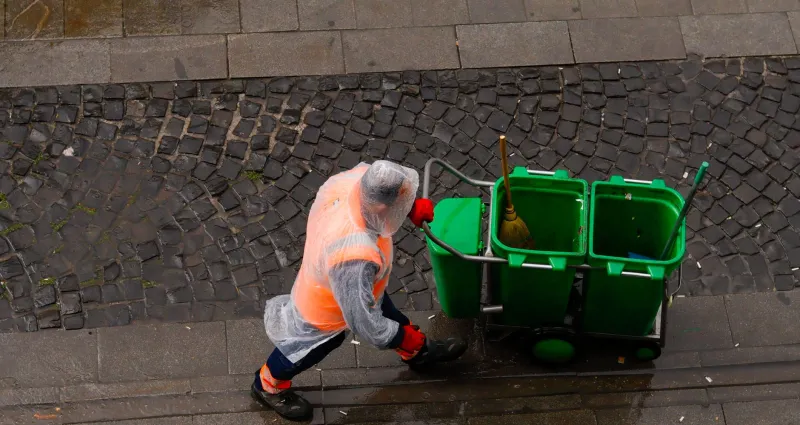
On a bright, cold morning, you might see one of the council sweepers working along a main road, the brush making that familiar grinding hum. It is not glamorous work, and it is often done before most of us have had our second cup of tea. Shopkeepers on the High Road and around the side streets do their bit too, sweeping leaves away from doorways and putting them in bags rather than pushing them into the gutter. Some do it because it is good for business. Most do it because it is good for the pavement.
Volunteers also play a part. Litter-picking groups and community-minded neighbours sometimes adopt a stretch of pavement for the season. They are not trying to replace the council. They are trying to stop a small problem becoming a bigger one. A pile of leaves left against a wall will eventually blow back across the path. A drain blocked with leaves will turn a rainy day into a puddle. A clear path, even a narrow one, makes the town feel looked after.
A practical guide to staying upright
If you are walking through Stapleford this month, the advice is not complicated. Wear shoes with a bit of tread. Take shorter steps on leaf-covered slopes. Use handrails where they exist. Cross at proper dropped kerbs rather than stepping out from between parked cars. If you are carrying shopping, keep one hand free for balance. And if you see a pavement that is genuinely dangerous, report it. The county and borough websites both have ways to flag street cleaning and highway issues. A short message with a location and a photo is more useful than a grumble on social media.
For homeowners and shopkeepers, the best approach is little and often. Clear your frontage before it becomes a slip hazard. Do not sweep leaves into drains, because they will block them. Bag them for green waste if your collection allows, or compost them. If you are organising a volunteer tidy-up, coordinate with the council so the bags are collected and the leaves are not simply moved from one place to another. And if you are a walker, do not kick through leaf drifts for fun. That is how the pile ends up on the path again.
The quiet ritual
Leaf clearing is one of those jobs that only gets noticed when it is not done. A swept pavement is a small public courtesy, a message that someone has thought about the person who might walk this way with a buggy, a stick, or a bag of shopping. It is not a grand civic statement. It is just a broom, a bit of timing, and a willingness to deal with the mess that autumn leaves behind.
So this November, if you see someone sweeping up outside their shop, say thanks. If you spot a bad patch near a school gate, report it. And if you have a broom and a spare ten minutes, clear the bit outside your own door. Stapleford's pavements are shared ground. Keeping them walkable is one of the quiet ways the town looks after itself.