The 19:42 Doesn’t Wait: Stapleford After Dark, Seen From the Back Seat
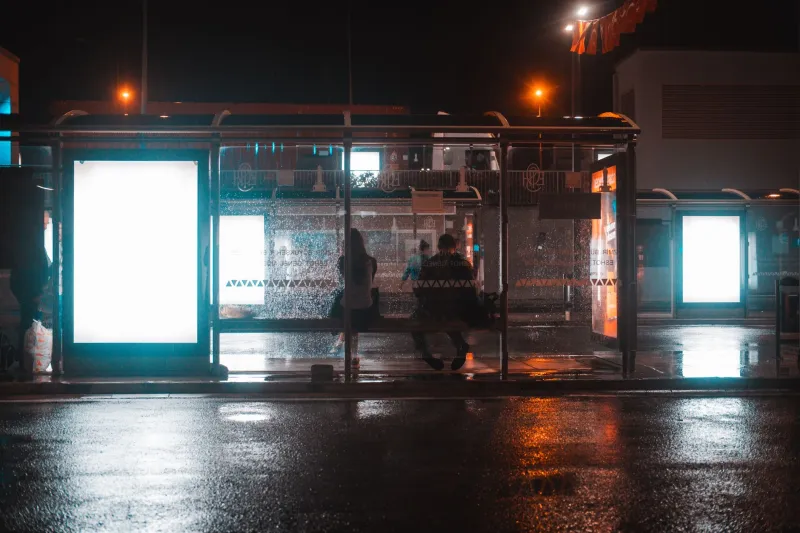
There is a particular kind of quiet that settles on a bus stop after the shops have locked up and before the pubs have properly warmed through. In Stapleford, on a damp November evening in 2026, that quiet has a timetable. The 19:42 is due. Nobody is romanticising it. They are checking their phones, shifting their weight and wondering whether the driver will see them in the gloom.
This is not the last bus of the night in the literal sense. It is the last bus that still feels ordinary — the one that can carry a shop worker home, a quiz team into town and a teenager back from a friend’s house without the whole evening turning into a negotiation about taxis. Call it the last useful bus. Every town has one. Stapleford’s tells you a lot about the town it serves.
The Stop Before the Rush
At ten minutes to seven, the pavement outside the library is doing a strange shift change. A woman in a supermarket fleece arrives first, still carrying the smell of the bakery aisle. Two lads in hoodies drift up, earbuds in, not speaking. A man with a folded copy of the local paper stands slightly apart, as if he has been catching this bus since before any of us were born and does not wish to make a thing of it.
Then the pub-quiz contingent arrives, not as a team but in twos and threes, clutching phones with answers on them and the particular confidence of people who have just argued about a tie-breaker. They are not loud yet. The night is still in its pencil outline.
What strikes you is how ordinary it all is. The bus stop is not a social club. It is a small, temporary waiting room with no walls, and everyone in it has a reason to be there that is both intensely personal and completely unremarkable. That is the point. A town after dark is made of these small, practical movements, not just the headline events.
Who Gets On
The 19:42 pulls in with a sigh of brakes and the interior light doing its best. The shop worker taps her card and takes the seat nearest the door. The lads go upstairs. The quiz team spreads out along the back, already whispering about the music round. A carer in soft shoes gets on last, carrying a bag that looks like it has done a full shift of its own.
You do not need names to see the pattern. This bus is a cross-section of Stapleford’s evening economy, and most of that economy is not glamorous. It is people finishing shifts, starting shifts, visiting relatives, going to cheap and cheerful nights out, or simply getting from one side of town to the other without asking for a lift. Teenagers use it because it gives them a bit of freedom. Older residents use it because it keeps them connected. Workers use it because the alternative is a walk along roads that were not designed for pedestrians after dark.
The back seat view is revealing. Through the window, Stapleford goes by in fragments: the lights of a takeaway, a chippy shutting up, the pale glow of a phone shop, a dog walker crossing at the lights. The town looks smaller from up here, and more human. You notice the gaps between the lit bits.
The Small Gaps
The 19:42 is useful, but it is not a magic carpet. The gaps matter. If you finish work at half seven on the wrong side of town, you may already be looking at a long wait or a lift. If you are a carer finishing late, the return journey can be the part that keeps you awake. If you are fifteen and you miss it, the evening gets complicated quickly.
This is where the romance of the last bus falls away. A bus service is not a public good simply because it exists. It is a public good when it connects the places people actually need to go, at the times they actually need to go there. Stapleford’s evening buses do a lot of quiet heavy lifting, but they cannot do everything. The gaps are not failures of the town’s character. They are just gaps — the sort of thing that a good local conversation can name without turning into a row.
What the 19:42 reveals is not a town that shuts down at dusk. It is a town that keeps moving in a lower gear. The pub quiz team will be back on a later bus, or a taxi, or a lift from a mate. The shop worker will be home before the kettle has boiled. The carer will be thinking about tomorrow’s shift. Everyone on board is making the evening work in their own way.
How to Catch It Without the Romance
If you want to use the evening buses rather than just write poems about them, a few practical things help. First, check the live timetable on the operator’s app or Traveline before you leave the house. Printed timetables are useful, but the live version is the one that knows about roadworks and missing drivers. Second, arrive five minutes early. The 19:42 does not wait for anyone’s good intentions.
Third, know your stop. Stapleford has plenty of them, and not all are equal after dark. Main-road stops near the library, the shops and the main junctions tend to be better lit and busier. If you are unsure, ask the driver to tell you when you are close. Most will. Fourth, have a payment plan: contactless is widely accepted, but keep a fallback in case the card reader is having a moment. Fares and day tickets vary, so check before you board rather than guessing.
Finally, plan the return before you go out. The outbound bus is the easy part. The last bus home is the one that decides whether the evening was worth it. Charge your phone, share your location with someone if you are travelling alone, and give yourself a buffer. If the gaps in the timetable do not work for you, that is not a personal failing. It is useful information.
The Town in the Window
By the time the 19:42 reaches its next stop, the quiz team has moved on to a disagreement about geography and the shop worker has her eyes closed. The bus is warm and slightly steamy. Outside, Stapleford is a string of orange streetlights and dark hedges. It is not a postcard. It is better than that. It is a working town doing its evening rounds.
The last useful bus does not solve everything. It will not replace a car for every journey or patch every gap in the timetable. But it does something quietly valuable: it keeps the town connected after the first wave of the evening has gone home. If you have never caught it, try it once. Not for the romance. For the view from the back seat, and for the reminder that a town after dark is only as good as the journeys that are still possible.